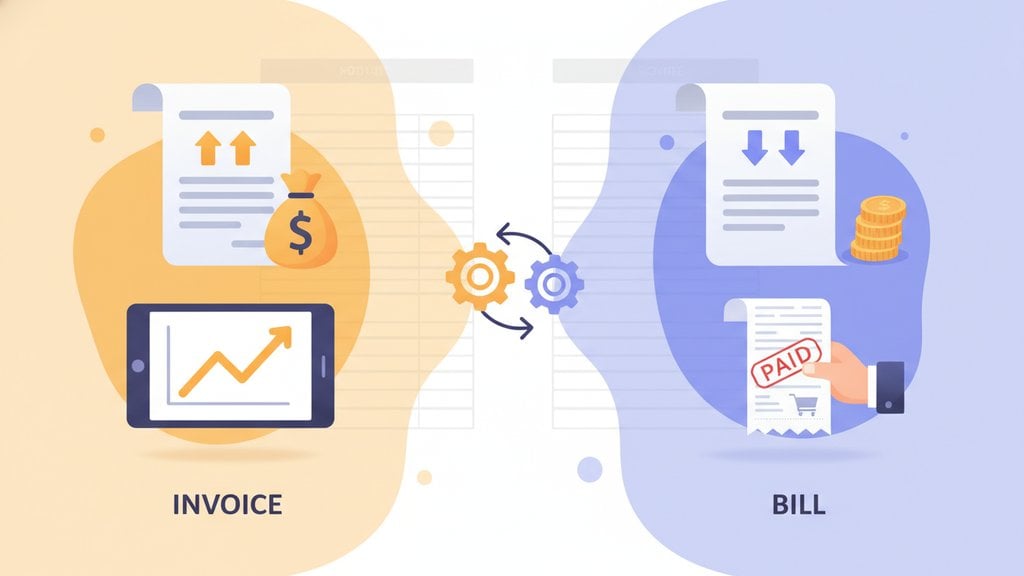
An invoice and a bill are actually the same document viewed from two different sides of a transaction. When you send one to a client, it's an invoice. When your client receives it, they call it a bill. That's the core of the invoice vs bill debate in accounting, and most of the confusion dissolves once you see it that way.
Content Table
Same Document, Two Names
Think of it like a handshake. You extend your hand; the other person grasps it. One action, two perspectives. In accounting, a single payment request document gets labeled differently depending on who is holding it:
- Invoice: The seller's perspective. You created it, you sent it, you track it as accounts receivable.
- Bill: The buyer's perspective. You received it, you owe money, you record it as accounts payable.
A plumber who fixes your pipes sends you an invoice. You, the homeowner, receive a bill. The piece of paper is identical. The accounting entry is what changes.
Where the Terms Actually Diverge
While the documents are functionally the same, there are a handful of real-world contexts where the two terms do carry slightly different weight.
Timing and formality
Invoices are almost always issued for goods or services delivered on credit, meaning payment comes after the work is done. Bills, in everyday language, often imply immediate or near-immediate payment. Your electricity bill is due at the end of the month. A freelance designer's invoice might have net-30 payment terms. The underlying obligation is the same; the urgency implied by the word differs.
Who uses which word
- B2B (business to business): "Invoice" dominates. Contracts, purchase orders, and accounting systems all use invoice language.
- B2C (business to consumer): "Bill" is more common. Utility companies, restaurants, and subscription services bill their customers.
- Healthcare: Patients get a bill. Insurance companies process a claim. Providers send an invoice to insurers.
- Legal and professional services: Attorneys and consultants almost always use "invoice," partly because it signals a formal, documented request.
The accounts payable vs accounts receivable split
In double-entry bookkeeping, this distinction matters for how you categorize the document. When you receive a supplier's invoice, your accounting software books it as a bill (accounts payable). When you issue one to a client, it sits in accounts receivable. QuickBooks, for example, literally uses the menu label "Enter Bills" for supplier invoices you receive and "Create Invoices" for ones you send. Same document, different ledger entry.
If you want to see how an invoice compares to a completely different document, check out this breakdown of invoice vs receipt differences since receipts are often confused with both terms.
Billing Terminology in Accounting Software
Most accounting platforms have quietly standardized their billing terminology to reduce confusion. Here's how the major categories map out:
| Document Name | Who Creates It | Who Receives It | Accounting Entry |
|---|---|---|---|
| Invoice | Seller / service provider | Buyer / client | Accounts receivable (seller) |
| Bill | Same document as above | Same | Accounts payable (buyer) |
| Receipt | Seller | Buyer | Confirms payment already made |
| Statement | Seller | Buyer | Summary of multiple invoices/bills |
Invoice Types You Should Know
Once you move past the basic invoice vs bill distinction, accounting terms branch out into specific invoice types. Each serves a different purpose in the billing lifecycle:
- Standard invoice: The most common type. Lists goods or services delivered, the amount owed, and payment terms.
- Proforma invoice: A preliminary estimate sent before work begins or goods ship. It is not a payment demand. Learn more about proforma invoice format and when to use one.
- Credit invoice (credit note): Issued when you need to cancel or reduce a previous invoice, for example after a return or discount.
- Recurring invoice: Sent on a fixed schedule for ongoing services, like a monthly retainer or SaaS subscription.
- Past-due invoice: An invoice that has not been paid by its due date. Understanding when an invoice crosses into overdue territory matters for collections and late fees.
- Timesheet invoice: Common in consulting and legal work. Breaks down hours worked and the hourly rate.
None of these are called "bills" in professional billing contexts, even though the buyer records each one as a bill in their own books.
Practical Rules for Your Business
For most small business owners and freelancers, the terminology you use on the document itself matters less than what it contains. A valid payment request needs:
- Your business name and contact details
- The client's name and address
- A unique invoice number
- Issue date and payment due date
- Itemized list of goods or services with amounts
- Total amount due, including applicable taxes
- Payment instructions (bank details, accepted payment methods)
If you want to stop spending time manually creating these documents, invoice automation can handle recurring billing and follow-ups without any manual effort.
And if you want to understand what makes an invoice legally compliant rather than just functional, the invoice requirements guide covers exactly what fields are mandatory depending on your country and business type.

Send your first invoice in under 2 minutes
Whether you call it an invoice or a bill, BlueInvoice lets you create a professional, itemized payment request instantly, with five design styles and no account required to get started.
Create a Free Invoice →
No, there is no legal distinction between an invoice and a bill in most jurisdictions. Both refer to the same payment request document. Tax authorities and courts treat them identically as long as the document contains the required fields: seller details, buyer details, itemized charges, date, and total amount. The word you use on the document does not affect its legal standing.
Accounting software uses both terms to reflect the two sides of a transaction in your own books. "Create Invoice" means you are recording money owed to you (accounts receivable). "Enter Bill" means you are recording money you owe to a supplier (accounts payable). The underlying document from the supplier is still called an invoice, but your software logs it as a bill from your perspective.
Technically yes, but it is not recommended in professional B2B contexts. Using the word "invoice" signals formality, makes it easier for your client's accounts payable team to process, and aligns with standard accounting terminology. Calling it a bill is fine for casual or consumer-facing work, but for corporate clients, stick with "invoice" to avoid any processing delays.
An invoice is a request for payment before money changes hands. A receipt is proof that payment has already been made. You send an invoice first; you issue a receipt after the client pays. Never use a receipt as a substitute for an invoice, because a receipt does not create a legally documented payment obligation the way an invoice does.
No. Tax authorities care about the content of the document, not what you call it. For VAT purposes, a valid tax invoice must include your VAT number, the buyer's VAT number (for B2B), the tax rate applied, and the tax amount. As long as those fields are present, calling it an invoice or a bill makes no difference to your VAT filing or the buyer's ability to reclaim input tax.
A proforma invoice is a preliminary estimate or quote sent before work is completed or goods are shipped. It is not a formal payment demand and does not get recorded as accounts receivable or accounts payable. Think of it as a preview of what the final invoice will look like. Once the work is done or goods are delivered, you issue a standard invoice to replace it.