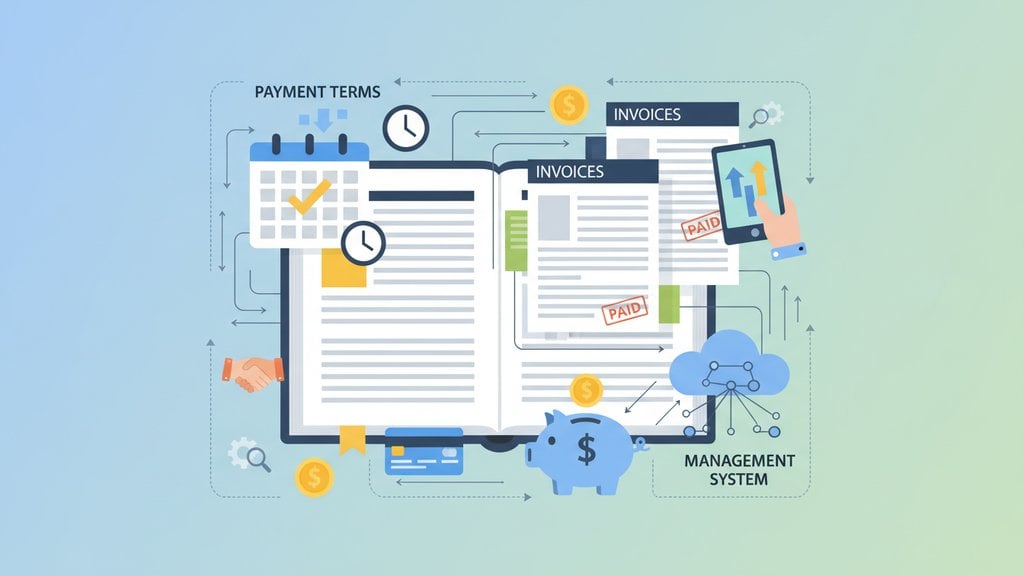
Payment terms are the rules you set on an invoice that tell your client when and how they need to pay you. Choosing the right payment terms for your small business can be the difference between steady cash flow and scrambling to cover your bills while waiting on overdue invoices. The good news is that you have more flexibility here than most people realize.
Content Table
What Are Payment Terms?
Payment terms are a formal agreement between you and your client that spells out three core things: when payment is due, what payment methods are accepted, and what happens if the deadline is missed. They appear on your invoice and, ideally, in your contract too.
They are not just bureaucratic boilerplate. Payment terms actively shape your business cash flow. A freelancer billing $5,000 a month under Net 60 terms is essentially giving their clients an interest-free $10,000 loan at any given time. That math matters when rent is due.
Common Payment Terms Explained
| Term | What It Means | Best For |
|---|---|---|
| Due on Receipt | Payment expected immediately when the invoice is received | One-off jobs, new clients, small amounts |
| Net 7 | Payment due within 7 days | Short-term projects, digital deliverables |
| Net 15 | Payment due within 15 days | Small businesses with regular clients |
| Net 30 | Payment due within 30 days | B2B invoicing, established relationships |
| Net 60 / Net 90 | Payment due within 60 or 90 days | Large enterprise clients, high-volume suppliers |
| 50% Upfront | Half paid before work starts, half on completion | Custom projects, creative work, contractors |
| 2/10 Net 30 | 2% discount if paid within 10 days, full amount due in 30 | Encouraging early payment from reliable clients |
| EOM (End of Month) | Payment due at the end of the month the invoice is issued | Businesses with monthly billing cycles |
Net 30: The Default That Is Not Always Best
Net 30 is the most widely used invoice payment term in B2B transactions, largely because it became the industry default decades ago. It gives clients a full 30-day window from the invoice date to send payment. That is generous, and for many small businesses, it is too generous.
Here is the honest breakdown:
- Pro: Clients expect it, especially in corporate procurement environments
- Pro: Gives buyers time to process invoices through their accounts payable system
- Con: 30 days often becomes 45 or 60 in practice, because late payment is extremely common
- Con: If you invoice on the 1st and get paid on the 30th, you may have already paid your own suppliers
- Con: New clients have no incentive to prioritize your invoice over others
According to the Federal Reserve's Small Business Credit Survey , late payments are one of the top financial challenges reported by small business owners. Net 30 is not inherently bad, but it should be a deliberate choice, not a default you inherited from a template.
Choosing the Right Terms for Your Business
There is no single best payment term. The right choice depends on your industry, your client base, and how tight your own cash position is.
Ask yourself these questions first:
- How long can you wait to be paid without affecting your operations?
- Is this a new client or a long-standing relationship you trust?
- What does your industry typically use? (Construction often runs Net 30-60; freelancers commonly use Net 14 or Net 15.)
- Is the project large enough to justify a deposit upfront?
- Does your client have a formal accounts payable process that requires Net 30 minimum?
A simple framework by business type:
- Freelancers and solo consultants: Net 14 or Net 15, with a 25-50% deposit on projects over $1,000
- Service businesses (marketing, IT, design): Net 15 to Net 30, milestone billing for long projects
- Product-based small businesses: Due on receipt or Net 7 for retail; Net 30 for wholesale
- Contractors and tradespeople: 30-50% upfront, remainder on completion
- Agencies working with enterprise clients: Net 30, with a clear late fee clause
How Payment Terms Affect Your Business Cash Flow
Business cash flow is directly tied to the gap between when money goes out and when it comes in. Payment terms control the "comes in" side of that equation.
Consider a concrete example. A web designer completes three $3,000 projects in January and invoices all three on January 31 under Net 30 terms. In February, they still have $0 coming in from those jobs. They get paid in early March, two months after doing the work. If they have monthly software subscriptions, subcontractor costs, or rent, they are funding those from reserves or credit.
Switching those same projects to Net 14 would move the cash inflow to mid-February. Switching to 50% upfront would put $4,500 in their account in January before the work even begins.
The U.S. Small Business Administration recommends that small businesses maintain at least three months of operating expenses in reserve, partly because invoice payment delays are so common. Tighter payment terms reduce how much reserve you need to carry.
Practical Tips for Getting Paid Faster
Even the best payment terms on paper do not help if clients ignore them. These tactics make a real difference:
- Invoice immediately. Send the invoice the moment the work is done or the milestone is hit. Delays on your end signal that urgency is optional.
- Make payment easy. Accept credit cards, ACH transfers, and digital wallets. Every extra step between "I want to pay" and "payment sent" increases late payments.
- Add a late fee clause. Something like "1.5% per month on balances unpaid after the due date" is standard and legally enforceable in most U.S. states. Mention it in your contract and on the invoice.
- Send a reminder before the due date. A friendly "just a heads up, your invoice is due in 3 days" email catches honest forgetters before they become late payers.
- Use a deposit for new clients. You have zero leverage once the work is delivered. A 25-50% deposit upfront changes that dynamic entirely.
- Keep your invoices clean and clear. Confusing invoices get questioned, disputed, and delayed. A clear itemized invoice with a visible due date gets paid faster.
How to Word Payment Terms on an Invoice
The language you use on your invoice matters. Vague terms create disputes. Here are examples of clear, professional wording you can use directly:
- Standard Net 30: "Payment due within 30 days of invoice date."
- Due on receipt: "Payment due upon receipt of this invoice."
- Early payment discount: "2% discount if paid within 10 days. Full amount due within 30 days."
- Late fee: "Invoices unpaid after 30 days are subject to a 1.5% monthly late fee."
- Deposit already received: "Deposit of $500 received. Remaining balance of $1,500 due within 14 days of delivery."
- Milestone billing: "This invoice covers Phase 1 completion. Final payment of $2,000 due upon project sign-off."
Invoices that use specific due dates ("due by February 14") rather than relative terms ("due in 30 days") tend to get paid faster - the deadline feels more concrete and harder to ignore. If your invoicing tool supports it, always print the exact calendar date alongside the term.
Getting your payment terms right is one of the highest-leverage moves you can make as a small business owner. It costs nothing to change, it does not require a lawyer, and the impact on your cash flow can show up within the next billing cycle.
Create invoices with the right payment terms built right in
BlueInvoice lets you build professional invoices where your payment terms, due dates, and late fee clauses are clearly displayed every time. Stop chasing late payments and start invoicing with terms that protect your cash flow.
Create Your Free Invoice →
Net 30 is the most widely used payment term in B2B invoicing, meaning payment is due within 30 days of the invoice date. However, many small businesses are moving toward Net 14 or Net 15 to improve cash flow, especially for service-based work where the deliverable is handed over immediately and there is no reason to wait a full month for payment.
Yes, in most U.S. states and many other countries you can charge a late fee as long as it was disclosed before the work began, typically in your contract and on your invoice. A common rate is 1.5% per month on the outstanding balance. Always include the late fee policy in writing before you start a project so it cannot be disputed later.
For most project-based work, yes. A deposit of 25% to 50% upfront protects you if a client disappears mid-project and gives you working capital before you spend time and resources. It also filters out low-commitment clients. For ongoing retainer work or repeat clients you trust, a deposit may not be necessary, but it is always reasonable to ask for one.
"2/10 Net 30" is an early payment discount term. It means the client gets a 2% discount if they pay within 10 days; otherwise the full amount is due within 30 days. It is a smart way to incentivize faster invoice payment without being pushy. For clients with strong cash positions, the 2% savings is attractive, and you benefit from receiving money three weeks earlier.
"Due on receipt" means payment is expected as soon as the client receives the invoice, which in practice often means within a few business days. Net 7 gives a clear, defined 7-day window from the invoice date. Net 7 is generally more professional because it sets a specific, measurable deadline, while "due on receipt" can feel vague and is harder to enforce if a client claims they did not receive the invoice promptly.
Offering longer terms like Net 60 or Net 90 can make you more attractive to large corporate clients who have rigid accounts payable cycles, but it puts strain on your own cash flow and may force you to use a business credit line to bridge the gap. Shorter terms signal that you run a professional operation. Most established clients respect clearly stated terms, especially when they are communicated upfront and consistently applied.